The sample rewrite: Lantern Moths.
An invented game: a 2–4 player card and tile game about drawing moths to your lantern. The draft below is 700 words of designer's notes, v4; the rewrite is about 1,000 words in the standard order. Every rule in the draft is in the rewrite; nothing is in the rewrite that the draft did not say, and the seven places it could be read two ways are listed at the end, undecided.
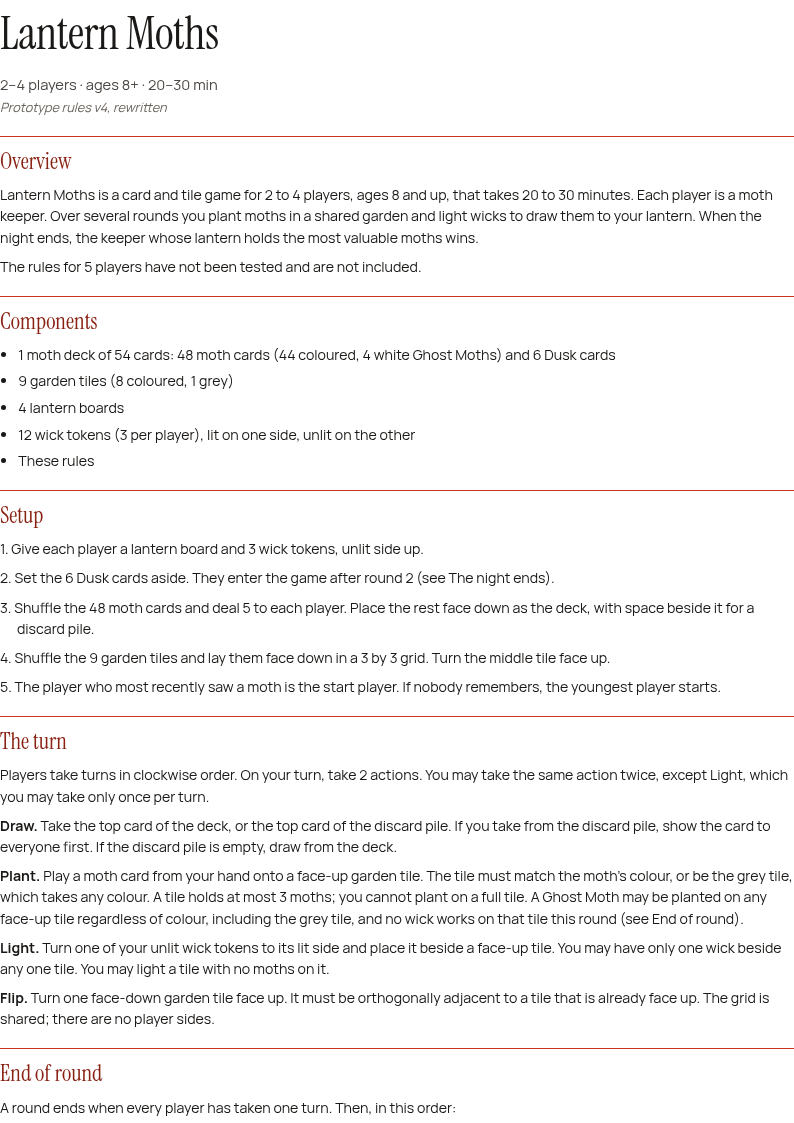
Before: the designer's draft, as sent.
LANTERN MOTHS rules v4 (draft!!)
So the idea is you are moth keepers and you are trying to get the most moths to your lanterns before the night ends. 2-4 players, maybe 5 works but we haven't tested it. Ages 8ish and up, takes 20-30 mins.
Everyone gets a lantern board and 3 wick tokens and you shuffle the moth deck (the 48 cards, NOT the 6 dusk cards, those get shuffled in later, see below) and deal 5 to everyone. Put the garden tiles out in a 3x3 grid, actually put them face down first then flip the middle one. Oh and the start player is whoever last saw a moth, or youngest if nobody remembers.
On your turn you do 2 actions, same one twice is fine except Light which you can only do once. Actions are: Draw a moth card (from the deck or the top of the discard, but if you take from discard you have to show it), Plant a moth (play a card from your hand onto a garden tile that is face up, the tile has to match the moth's colour OR be the grey tile which takes anything, max 3 moths per tile), Light (flip one of your wick tokens to the lit side and put it next to a tile — now moths on that tile come to your lantern at the end of the round, but ONLY if your lit wick is the only one on that tile, if there are two lit wicks on a tile the moths stay put, this is important), Flip (turn over a face-down garden tile next to a face-up one).
Actually one more thing about Plant - if the tile is full you can't plant there obviously, and if you plant a Ghost Moth (the 4 white ones) it goes on top of any tile regardless of colour and nobody's wick works on that tile that round. We go back and forth on whether the ghost moth should also block the grey tile. For now yes.
After everyone has taken their turn, that's a round, and you do the end of round thing: for every tile with exactly one lit wick, that player takes all the moths on it and puts them face down by their lantern (these are your scored moths, don't look at them again until the end, well you can look at your own). Then everyone flips their wicks back to unlit and takes them back. Then draw back up to 5. Then the start player moves to the left.
The dusk cards - after round 2 shuffle the 6 dusk cards into the deck. When a dusk card is drawn put it face up in the middle, that doesn't count as your draw, draw again. When the 4th dusk card comes out the night is ending: finish the current round and then that's the game. (If the deck runs out before that, also the game ends after the current round, this happened once in testing.)
Scoring: each moth card has a number 1-3 on it, add them up. Sets: if you have 3 moths of the same colour that's +4. Ghost moths are worth 0 but each one you have cancels out one of your lowest moths... no wait we changed that, ghost moths are worth 2 each now and that's it. Most points wins, ties go to whoever has more moths, then whoever has fewer ghost moths, then share it.
Things people asked: Can you Light a tile with no moths on it? Yes but why would you. Can two of your own wicks be on the same tile? No, one wick per tile per player. What if the discard is empty? Then draw from the deck. If the grey tile has a ghost moth on it does the "takes anything" rule still... we said yes above. Can you flip a tile on your opponent's side - there are no sides, the grid is shared. What happens to moths on a tile that nobody lights? They stay there, they can pile up to 3 and then the tile is full.
Solo rules: TBD.
Thanks to the Thursday group for playtesting!!
After: the rewrite.
OVERVIEW
Lantern Moths is a card and tile game for 2 to 4 players, ages 8 and up, that takes 20 to 30 minutes. Each player is a moth keeper. Over several rounds you plant moths in a shared garden and light wicks to draw them to your lantern. When the night ends, the keeper whose lantern holds the most valuable moths wins.
The rules for 5 players have not been tested and are not included.
COMPONENTS
1 moth deck of 54 cards: 48 moth cards (44 coloured, 4 white Ghost Moths) and 6 Dusk cards
9 garden tiles (8 coloured, 1 grey)
4 lantern boards
12 wick tokens (3 per player), lit on one side, unlit on the other
These rules
SETUP
1. Give each player a lantern board and 3 wick tokens, unlit side up.
2. Set the 6 Dusk cards aside. They enter the game after round 2 (see The night ends).
3. Shuffle the 48 moth cards and deal 5 to each player. Place the rest face down as the deck, with space beside it for a discard pile.
4. Shuffle the 9 garden tiles and lay them face down in a 3 by 3 grid. Turn the middle tile face up.
5. The player who most recently saw a moth is the start player. If nobody remembers, the youngest player starts.
THE TURN
Players take turns in clockwise order. On your turn, take 2 actions. You may take the same action twice, except Light, which you may take only once per turn.
Draw. Take the top card of the deck, or the top card of the discard pile. If you take from the discard pile, show the card to everyone first. If the discard pile is empty, draw from the deck.
Plant. Play a moth card from your hand onto a face-up garden tile. The tile must match the moth's colour, or be the grey tile, which takes any colour. A tile holds at most 3 moths; you cannot plant on a full tile. A Ghost Moth may be planted on any face-up tile regardless of colour, including the grey tile, and no wick works on that tile this round (see End of round).
Light. Turn one of your unlit wick tokens to its lit side and place it beside a face-up tile. You may have only one wick beside any one tile. You may light a tile with no moths on it.
Flip. Turn one face-down garden tile face up. It must be orthogonally adjacent to a tile that is already face up. The grid is shared; there are no player sides.
END OF ROUND
A round ends when every player has taken one turn. Then, in this order:
1. For each tile with exactly one lit wick beside it, the owner of that wick takes every moth on the tile and places them face down beside their lantern. These moths are scored at the end of the game. You may look at your own; nobody looks at another player's.
2. A tile with two or more lit wicks beside it keeps its moths. A tile with a Ghost Moth on it keeps its moths, whatever wicks are beside it. Moths that stay on a tile remain there into the next round and still count towards the limit of 3.
3. Every player turns their wicks unlit side up and takes them back.
4. Every player draws from the deck until they hold 5 cards.
5. The start player passes to the left.
THE NIGHT ENDS
After the end of round 2, shuffle the 6 Dusk cards into the deck.
When anyone draws a Dusk card, they place it face up in the middle of the table and draw again; the Dusk card does not count as the draw. This applies both to a Draw action and to drawing up to 5 at the end of a round.
When the fourth Dusk card is placed, the night is ending: finish the current round, including the end-of-round steps, and the game is over.
If the deck runs out before the fourth Dusk card, finish the current round in the same way, and the game is over.
SCORING
Each player totals the moths beside their lantern:
Every moth card is worth the number printed on it (1 to 3).
Every Ghost Moth is worth 2.
Every set of 3 moths of the same colour is worth 4 extra points. Each moth counts in one set only.
The player with the most points wins. On a tie, the tied player with more moths wins; if still tied, the one with fewer Ghost Moths wins; if still tied, the players share the win.
EDGE CASES
Lighting an empty tile is allowed. The wick stays there and stops at the end of the round like any other.
Two of your own wicks may not be beside the same tile. Wicks from different players may be beside the same tile, and then nobody takes its moths that round.
A Ghost Moth counts towards the limit of 3 moths on a tile.
A tile nobody lights keeps its moths. Once it holds 3, nothing more may be planted there until a wick takes them.
Solo play: not included. The prototype marks it as not yet written.
INDEX OF TERMS
Deck: the face-down stack of moth cards (and, after round 2, Dusk cards).
Discard pile: face-up cards beside the deck; the top card may be drawn.
Dusk card: one of 6 cards that mark the end of the night; the fourth ends the game.
Full tile: a tile holding 3 moths.
Garden: the shared 3 by 3 grid of tiles.
Ghost Moth: one of 4 white moth cards; plants anywhere, blocks every wick on its tile that round, scores 2.
Grey tile: the one tile that accepts moths of any colour.
Lantern: your scoring area; moths taken by your wick go here face down.
Lit wick: a wick token placed lit side up beside a tile during a Light action.
Round: one turn by every player, followed by the end-of-round steps.
Set: 3 moths of one colour beside your lantern, worth 4 extra points.
The change log: what moved and why.
1. Components listed in one place
The prototype named the 48-card deck, the 6 Dusk cards, the tiles and the wicks across four paragraphs; a reader setting up for the first time needs them before anything else.
2. Setup numbered, Dusk cards set aside in step 2
The prototype said 'NOT the 6 dusk cards, those get shuffled in later, see below'. Same rule, now a step with a cross-reference.
3. The four actions given one paragraph each, in the order the prototype listed them
The prototype's Plant rule continued in a later 'one more thing' paragraph; the two are merged. Nothing added.
4. Ghost Moth on the grey tile stated once
The prototype said 'for now yes' and again in the questions. The rule stands as written by the designer: a Ghost Moth may go on the grey tile and blocks it.
5. End of round given numbered steps in the prototype's order
Taking moths, resetting wicks, drawing to 5, passing the start player. Same order as the prototype.
6. Dusk-card draw rule extended to the end-of-round draw
The prototype said 'when a dusk card is drawn'; the end-of-round draw also draws cards, so the rule is stated for both. Flagged as question 2 in case the designer meant otherwise.
7. Ghost Moth scoring: the earlier 'cancels your lowest moth' version removed
The prototype crossed it out in the same sentence ('no wait we changed that'). Only the current rule, 2 points each, is kept.
8. The 'Things people asked' answers folded into The turn, End of round and Edge cases
Each answer now sits beside the rule it belongs to; the questions no longer need to be read as a list.
9. 5-player and solo play named as not included
The prototype said 'maybe 5 works but we haven't tested it' and 'Solo rules: TBD'. The rewrite says so plainly rather than leaving the box count open.
10. Playtester thanks left out of the rules body
Credits belong on the back page or the box; a line is suggested in the questions.
Questions for the designer.
1. Is a tile 'next to' a face-up tile only orthogonally, or also diagonally? The rewrite says orthogonally; change it if you meant otherwise.
2. When a Dusk card appears during the end-of-round draw to 5, should it be placed and replaced the same way as during a Draw action? The rewrite assumes yes.
3. If the fourth Dusk card appears during the end-of-round draw (after moths have already been taken), does the game end immediately, or is one more round played? The rewrite ends it there.
4. Can a Ghost Moth be planted on a full tile? The rewrite says no, because the limit of 3 applies to every moth; say if Ghost Moths are meant to ignore it.
5. In a set of 3 moths of one colour, does a Ghost Moth count as any colour? The rewrite says no; Ghost Moths are white and form no sets.
6. Does the player who draws the fourth Dusk card still draw a replacement card? The rewrite says yes.
7. Do you want a credits line ('Thanks to the Thursday group') on the back page? It is not in the rules body.
Download the sample PDF The Word file The text file Edit my rulebook →
The real rewrite is made from your own draft; the shape is the same.